
Switchgear tends to be judged by how it looks. Panels are clean, doors close properly, the thermographic survey came back clear, so the lineup gets signed off for another year.
Insulation trouble does not advertise itself that way. Long before a panel produces enough heat to show on a thermal camera, deteriorating insulation begins to discharge in tiny bursts inside voids, along tracking paths, and across contaminated surfaces. Those bursts are measurable, and finding them is the difference between a planned repair and a switchroom incident.
What Partial Discharge Is
A partial discharge is a small electrical breakdown that bridges only part of the insulation between two conductors. The insulation as a whole is still doing its job, so nothing trips and nothing obviously changes. Each discharge nonetheless erodes a little material, generates ozone and nitric compounds in air-insulated equipment, and gradually extends the defect that caused it.
The process is self-accelerating. A void that discharges becomes slightly larger, which raises the local field, which increases discharge activity, which enlarges the void further. Left alone, the sequence ends in complete breakdown across the remaining insulation, and in a medium voltage panel that means a phase-to-earth or phase-to-phase fault with all the energy the network can supply behind it.
Where It Starts in a Switchroom
Ageing switchgear in Singapore has a fairly predictable set of trouble spots. Cable terminations top the list, particularly heat-shrink and cold-shrink joints where a stress cone was not seated correctly during installation. Epoxy spouts and post insulators come next, especially where condensation and dust have combined to create a conductive film across the surface. Busbar supports, current transformer insulation, and voltage transformer connections all appear regularly too. Humidity is the common thread running through most of it, which is why switchrooms with marginal ventilation or failed anti-condensation heaters produce more findings than others. Most switchgear service programmes therefore begin by mapping these locations across a lineup, so that a survey concentrates effort where the defects realistically are.
The Measurement Methods
The reference method is electrical measurement of apparent charge, expressed in picocoulombs, defined in IEC 60270, the standard for charge-based measurement of partial discharges, whose fourth edition was published in 2025. It is precise and quantitative, and it normally requires the equipment to be de-energised and connected to a test supply, which makes it the natural choice at commissioning or during an outage.
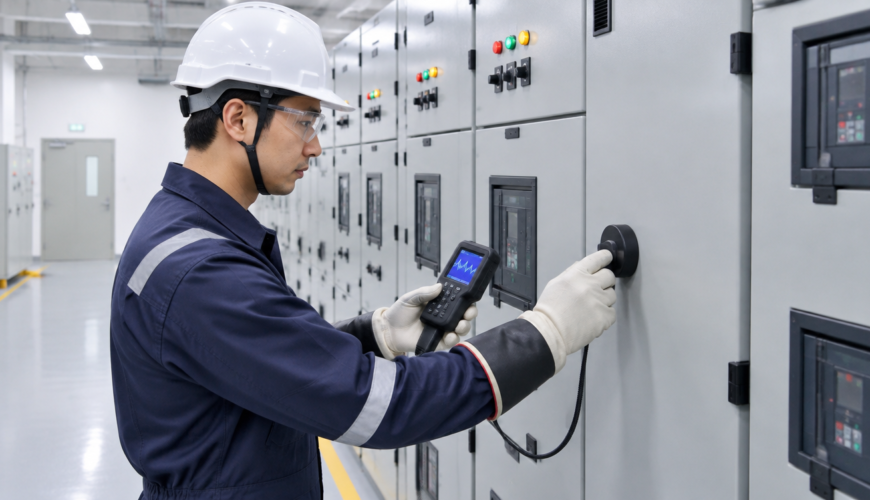
On-line methods take a different approach and detect the by-products of discharge instead. Transient earth voltage sensors pick up the electromagnetic pulse that discharge inside a metal-enclosed panel induces on the enclosure surface. Ultrasonic and airborne acoustic detectors pick up the sound of surface discharge through ventilation openings and door gaps. High frequency current transformers clamped around cable earths capture discharge travelling along the cable screen. These techniques and their limitations are described in IEC TS 62478, on measurement of partial discharges by electromagnetic and acoustic methods.
None of these methods gives a calibrated charge value, and none of them should be read as a pass or fail figure on its own. Their strength is comparison and trending: one panel against its neighbours in the same lineup, and the same panel against its own readings six months earlier. A survey that finds consistent activity at one cubicle, rising between visits, is a far more useful result than a single absolute number.
Running a Survey That Tells You Something
Conditions on the day shape the result more than most people expect. Load, humidity, and how recently the switchroom was cleaned all influence discharge activity, so surveys are best carried out under broadly comparable conditions each time and with those conditions recorded alongside the readings.
- Survey every cubicle in the lineup, not only the ones with a known history
- Record load current, ambient temperature, and relative humidity with each set of readings
- Use more than one detection method where possible, since electromagnetic and acoustic techniques find different defects
- Note any ozone smell, audible crackling, or visible tracking found during the same visit
- Keep results in a form that can be compared directly against the previous survey
Findings then need a proportionate response. Low-level activity on a single panel usually calls for closer monitoring and a shorter interval before the next survey. Activity that is rising steadily, or that is accompanied by ozone or visible tracking, calls for an outage and a physical inspection. Untreated discharge activity is one of the contributors to arc flash risks in ageing switchgear, so acting on a clear trend early keeps both the equipment and the people working around it in a better position.
Where It Fits With Local Requirements
Singapore installations already work to a defined inspection regime. SS 638, the code of practice for electrical installations sets the framework for testing and periodic verification, and licensed installations are inspected by an appointed Licensed Electrical Worker on intervals that depend on the installation type and voltage. Partial discharge surveying sits comfortably within that structure as an additional condition-based measure, and it gives the appointed engineer evidence about insulation health that visual inspection alone cannot provide. Because the survey is non-intrusive, it can also be repeated between statutory inspections without adding an outage to the calendar, which makes a genuine trend achievable within a year or two.
Making It Part of the Routine
The strongest argument for on-line surveying is simply that it can be done while the switchboard stays in service. A survey of a typical lineup takes a matter of hours, requires no shutdown, and produces a record that becomes more valuable with every repeat. We carry out testing, maintenance, and repair on high and low voltage switchgear, and surveys of this kind slot easily into an existing annual programme.
If your switchroom has been running for a decade or more without any insulation condition testing, a first survey is a sensible place to start and will tell you a great deal about where you stand. Contact the team at MES whenever you would like to talk about arranging one.

Linkedin Profile 