
Somewhere in most industrial sites in Singapore sits a switchboard installed when the building went up, still doing its job, and quietly becoming a problem. Spares have gone out of production, the relays are electromechanical, and the supplier who commissioned it has been out of the market for a decade.
Replacing the whole line-up means new enclosures, new cable terminations, civil work, and an outage nobody can find room for. A retrofit keeps the existing enclosure and busbar system and renews what has become unsupportable inside it. Knowing what that work actually involves makes the choice between the two far easier to weigh up.
The Survey Comes Before Any Decision
A retrofit starts with an assessment of what you already have, which is where our switchgear services usually begin. Engineers record the panel construction and dimensions, busbar arrangement and ratings, existing breaker types and their mounting geometry, cable entry and termination details, protection and metering schemes, control voltages, and interlocking arrangements. Thermographic survey results and contact resistance readings from earlier maintenance fill in the condition picture.
Two findings can stop a retrofit at this stage. Structural corrosion in the enclosure, and a busbar system whose rating no longer suits the fault level or the load the site has grown into, both point towards replacement instead. Establishing that early costs a site day and saves a wasted procurement cycle.
What Typically Gets Renewed
Most retrofits concentrate on the parts that fail, wear, or become obsolete first:
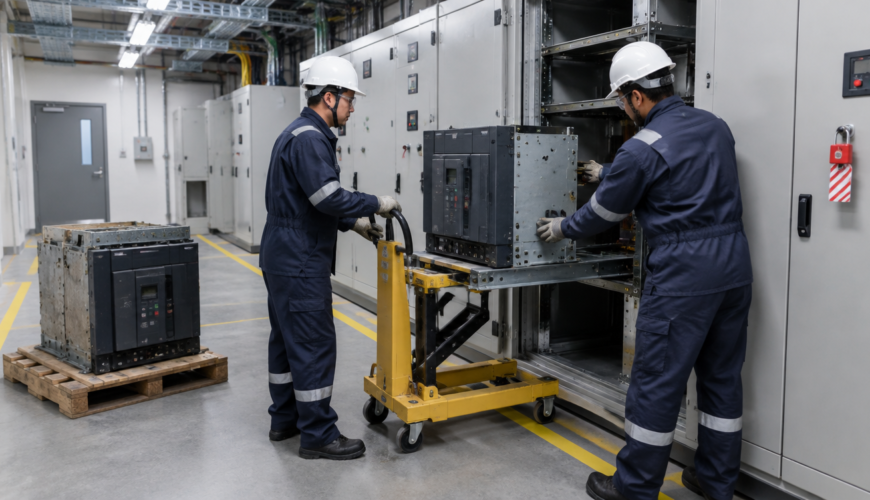
- Circuit breakers, replaced with current designs fitted using an adaptor arrangement into the existing cassette or cubicle
- Protection relays, moving from electromechanical or early static units to numerical devices with communications and event records
- Auxiliary components such as contactors, timers, control switches, indication, and terminal blocks
- Instrument transformers where the ratio, class, or burden no longer suits the new protection
- Interlocks, shutters, earthing arrangements, and labelling, updated to reflect current practice
- Cable terminations and glands, particularly where terminations have been disturbed repeatedly over the years
The Technical Limit Nobody Should Skip Over
Factory built assemblies are type tested as a complete configuration, and internal arc classification in particular applies to the arrangement that was tested. Modifying the contents of a cubicle can affect the basis of that classification, which is why any competent retrofit assesses the change against the requirements in IEC 62271-200 for medium-voltage assemblies, and against the equivalent low-voltage standard for switchboards, instead of assuming the original certification carries across unchanged.
This is also where the honest conversation about scope happens. A breaker swap that fits mechanically and functions correctly may still change fault clearing times, arc energy, or the coordination of upstream and downstream protection. Retrofits are engineered as a system, and the protection study is part of the work, not an optional extra bolted on afterwards.
How the Work Is Sequenced on a Live Site
Very few sites can release an entire switchboard at once, so retrofits are normally staged cubicle by cubicle or section by section across several short outages. Each stage follows the same pattern: isolate and earth under permit, remove the redundant equipment, install and wire the replacement, carry out primary and secondary testing, verify interlocks and indication, then return the section to service before the next one is opened.
Staging in this way keeps the site running, though it lengthens the overall programme and requires careful configuration control. Drawings, relay setting files, and asset records are updated at the end of every stage, because a half-documented switchboard is dangerous to work on and awkward to hand over. The same discipline behind any decision to optimally modernise your switchgear applies to the records the project leaves behind.
Isolation and re-energisation involve the site’s licensed electrical worker throughout, and the licensing arrangements set out by the Energy Market Authority determine who may take charge of the installation while the work proceeds. Agreeing that programme with the LEW before the first outage is what keeps a staged retrofit on schedule.
Testing Is What Proves the Job
Commissioning tests on a retrofitted panel cover insulation resistance, contact resistance, breaker timing and travel, primary and secondary injection of the new protection, trip circuit and interlock verification, and functional checks of indication and communications. Results are recorded against each cubicle so the site holds a complete baseline for future maintenance.
Weighing a Retrofit Against Replacement
Retrofits suit sites where the enclosure and busbars remain sound, the fault level has not moved significantly, space is tight, and the outage windows available are short. Replacement suits sites facing corrosion, an inadequate busbar rating, a significantly changed load, or a need to reconfigure the distribution arrangement anyway. Costs and durations vary with the number of cubicles, the equipment involved, and the access available, so treat early figures as indicative until the survey is complete.
The comparison also has a longer horizon. A retrofit typically buys a defined extension of service life with modern protection and available spares, while replacement resets the asset clock entirely. Both are legitimate answers, and the survey is what tells you which one your panel is asking for.
Making a Start on an Ageing Board
If spares for your breakers are becoming difficult to source, or your protection is still electromechanical, a survey is a small commitment that gives you a costed set of options and a clear view of the outages each would need. MES carries out annual servicing, maintenance, testing, installation, and troubleshooting on HV and LV switchgear across Singapore, and our engineers are happy to look at your existing boards and set out what a staged programme would involve. Contact us today.

Linkedin Profile 