
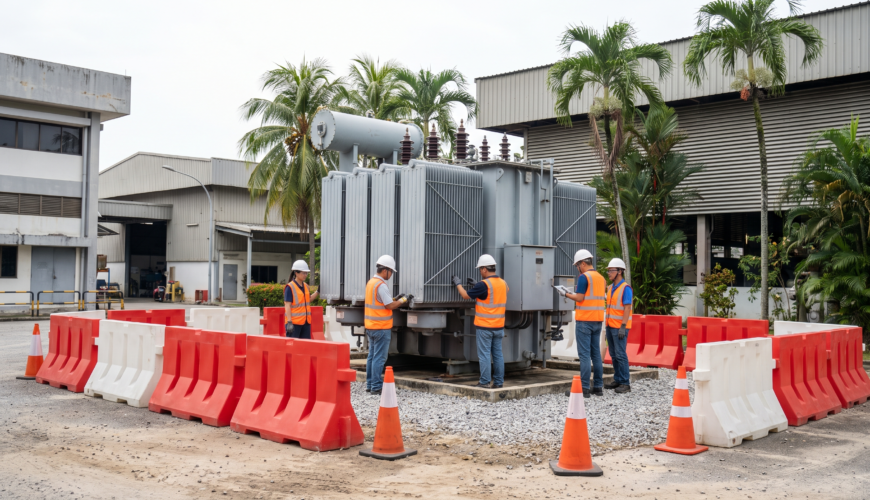
A transformer starts weeping oil from a gasket, or a routine test comes back with a moisture reading that has crept well above where it sat last year. Somewhere in the first hour of that conversation, a decision appears that shapes the cost, the duration, and the risk of everything that follows. Does the unit stay where it is, or does it go to a workshop?
The honest answer depends less on preference than on the fault itself, and on a set of site realities that are easy to underestimate until a crane is standing outside a substation door that turns out to be too narrow.
What Genuinely Can Be Done in Place
A great deal of transformer work belongs on site, and moving a unit that did not need to move introduces cost and handling risk for no benefit. External leaks and gasket replacement, bushing repair or replacement, cooling fan and pump work, protection and monitoring device replacement, oil filtration and regeneration, tap changer inspection and servicing, retrofilling with an alternative fluid, and the full range of electrical testing are all routinely completed in place by competent transformer service companies with the right equipment and access.
Where a Workshop Becomes the Right Answer
The line is usually crossed when the repair requires the core and coil assembly to come out of the tank. Rewinding, coil replacement, repairs to internal connections, work on the core itself, and any tank repair that involves a full drain and internal access all call for a controlled environment. Understanding transformer core and coil repair makes the reason obvious, since exposed windings and bare core steel are vulnerable to exactly the conditions a Singapore substation yard provides in abundance.
Severe moisture ingress is the other common trigger. Restoring the solid insulation to an acceptable dryness generally requires vacuum drying with heat under controlled conditions and sustained monitoring, which is impractical to reproduce on site for a large unit. Attempting it in the open risks a unit that tests acceptably on the day and disappoints within months.
Suspected internal faults belong in the same category. When dissolved gas results or electrical tests point to a problem inside the tank, the diagnosis itself may require internal inspection, and a partial answer is a poor basis for committing to a repair.
The Site Factors That Override Engineering Preference
Even where a workshop repair would be technically preferable, practical constraints can settle the question the other way:
- Crane and transport access, including door widths, headroom, floor loading, and the route from the substation to a road a low-loader can use
- Whether the installation can be taken out of service for the transport time as well as the repair time
- Availability of a spare unit, a mobile substation, or a temporary supply arrangement to cover the outage
- Weather exposure at the working position, since open tank work needs shelter, humidity control, and cleanliness
- The cost of lifting, transport, and reinstatement measured against the repair itself, which on smaller units can exceed the repair
- Statutory and licensing arrangements for isolating, reconnecting, and re-energising the installation
Settle the Licensing Question Early
Whichever way the repair goes, the electrical installation has to be isolated and returned to service correctly. Non-domestic installations in Singapore with an approved load above 45 kVA require an installation licence, and the owner appoints a licensed electrical worker of the appropriate class to take charge, as set out in the Energy Market Authority licensing requirements. Confirming who is doing that, and when they are available, has a habit of shaping the programme more than anyone expects.
The same applies to the paperwork around the outage itself. Permits, isolation certificates, and earthing arrangements are quicker to agree a fortnight ahead than on the morning the crane arrives.
Oil Handling Deserves Attention in Both Cases
Any work that opens the oil circuit brings the fluid itself into scope. Oil drained on site needs clean storage, and oil returned to a unit needs to meet condition limits before energisation. Recognised guidance on supervising oil in service, set out in IEC 60422, covers the tests and acceptance criteria used to demonstrate that. Where a unit is being retrofilled with an alternative fluid, compatibility with gaskets, seals, and residual mineral oil is checked in advance instead of discovered afterwards.
Site conditions influence the outcome here too. Filtration and top-up work carried out in the middle of a monsoon afternoon, without proper shelter, can leave a unit with more moisture than it started with. Scheduling around weather is a small discipline that protects the whole job.
Used oil also has to leave site responsibly, and the disposal or reclamation route belongs in the scope from the outset instead of being settled once the drums are already full.
How the Decision Usually Gets Made
In practice, the sequence is short. Establish what the fault is with testing and a visual inspection. Determine whether the repair needs internal access. Check whether the site can physically release the unit, and what covers the load in the meantime. Then compare the total cost and total downtime of each route, including transport, craneage, and reinstatement, and not only the repair line. Documenting that reasoning takes ten minutes and pays off later, particularly when the same question arises on a sister unit and the site conditions have changed.
Getting the Route Right the First Time
Neither route is inherently better. On-site work protects your programme when access is difficult and the fault is external. A workshop protects the quality of the repair when windings, core, or tank internals are involved. The expensive outcome is starting down one route, discovering halfway that the fault needed the other, and paying for both.
MES maintains, tests, repairs, installs, and commissions distribution and power transformers across Singapore, and our engineers assess each case on the fault and the site conditions before recommending a route. If you have a unit showing symptoms and would like a view on where the repair belongs, get in touch with us.

Linkedin Profile 