
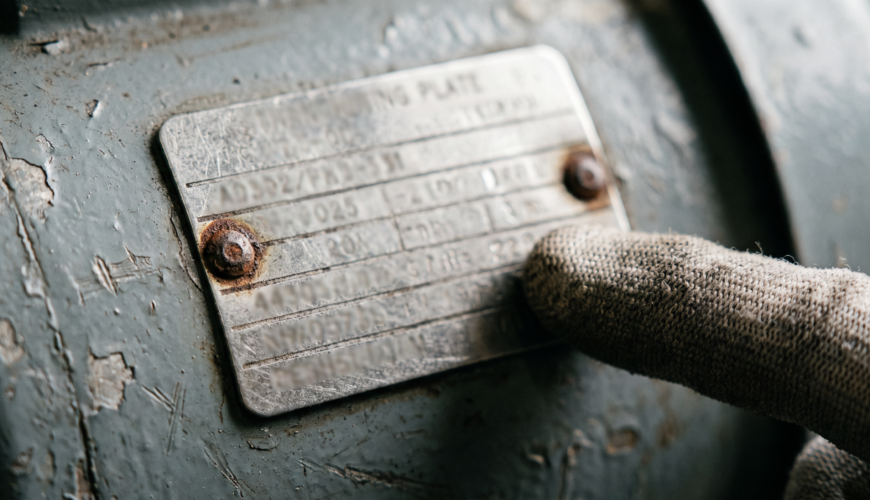
A photograph of a small metal plate can shorten a motor repair by several days. It arrives with the enquiry, and within minutes an engineer can tell you what the machine is, how it was meant to be wound, which bearings belong in it, and whether the replacement you are hoping for exists at all.
Rating plates get painted over, corroded, and occasionally removed during earlier repairs. The information they carry is the reference every later decision leans on, and a clear photograph of it is the first thing we ask for when an enquiry arrives for our motor and generator services. Understanding what each line does is a useful piece of housekeeping for any maintenance team.
Output, Voltage, and Current Set the Boundaries
Rated output in kilowatts, rated voltage, rated current, frequency, and rated speed together describe what the machine was designed to deliver. A workshop reads them as a set. Current drawn at rated load tells us what the winding was designed to carry, which becomes the check against any rewind data recovered from the failed winding. Speed and frequency confirm the pole count, and the pole count drives the winding layout.
The connection arrangement, whether star or delta, and the terminal marking convention are just as practical. A motor rewound and reconnected to a different arrangement than the site expects will run, briefly, and then present a problem that looks electrical but began as a paperwork error.
Insulation Class and Temperature Rise Are Two Different Things
Two of the most commonly confused entries sit next to each other. Insulation class describes the thermal capability of the insulation system, while temperature rise describes how hot the winding is permitted to get above ambient at rated load. A machine with class F insulation operating at class B rise carries useful thermal margin, and that margin is what buys insulation life in a hot plant room.
Ambient rating belongs to the same conversation. Plates commonly state a design ambient, and Singapore plant rooms regularly sit above the value a machine imported for a temperate market was rated against. When we scope a rewind, the insulation system and impregnation are chosen for the conditions the motor actually operates in, and the plate is where that comparison starts.
Duty type is the third piece. A machine rated for continuous running behaves differently from one rated for intermittent or short-time duty, and repeated starting on a continuously rated machine is a common reason windings fail earlier than anyone expected.
The Codes That Save Hours of Guesswork
Several coded entries answer questions that would otherwise require dismantling the machine or measuring it in place:
- Frame size and mounting arrangement, which determine whether a replacement will fit the existing bedplate and coupling
- Ingress protection rating, which tells us what the enclosure was designed to keep out and whether the installation still suits it
- Cooling method, which distinguishes a fan-cooled machine from one relying on forced ventilation or a water-cooled circuit
- Bearing designations at drive and non-drive ends, often the single most useful line on the plate for lead time purposes
- Efficiency class, which is defined for line operated AC motors in IEC 60034-30-1 and becomes a live consideration when a repair is weighed against replacement
- Serial and type number, which lets the original manufacturer’s records be traced where they still exist
How the Plate Shapes a Rewind
During a rewind, the winding data recovered from the failed winding is the primary source: turns per coil, wire size, span, connection, and slot fill are all recorded before anything is stripped. The plate is the cross-check on that record. When the two disagree, something has been changed at a previous repair, and knowing that early avoids reproducing an earlier mistake.
The plate also flags where a machine has already been modified. A rewound motor running at a voltage the plate does not list, or drawing a current well away from the rated figure, tells its own story. Recognising the main types of motor windings and how each is tested makes those discrepancies easier to interpret before a scope is agreed.
When the Plate Is Gone
Illegible and missing plates are common on older machines, and the position is recoverable. Frame dimensions, core and slot geometry, existing winding data taken during the strip, bearing sizes, and the driven load characteristics let an experienced workshop reconstruct the essential parameters. It takes longer, the first estimate carries wider tolerances, and any replacement decision becomes harder to make with confidence.
A Ten Minute Job That Pays for Itself
The cheapest insurance available here is a register. Photograph the rating plate of every significant motor on site, store the images against the asset number alongside the last test results, and update the record whenever a machine is repaired or rewound. Sites that do this send an enquiry with everything attached and get a considered scope back the same week. Sites that do not tend to lose the first two days of a breakdown to a torch, a wire brush, and a phone camera in an awkward corner of a plant room.
Keeping the record current also helps when equipment is being standardised. Comparing plates across the fleet often reveals that three different frame sizes are doing near-identical work, which is a straightforward opportunity to reduce the spares holding.
Putting the Information to Work
A rating plate is the shortest technical document you own, and it answers more questions in a repair conversation than any other single source. Read it, record it, and keep it legible, and every subsequent repair decision becomes faster and better founded. Our workshop covers overhauling, repairing, rewinding, and upgrading AC and DC machines for industrial clients across Singapore. Send us a photograph of the plate and a description of the symptoms, and our engineers can tell you quickly what the sensible next step looks like.

Linkedin Profile 