
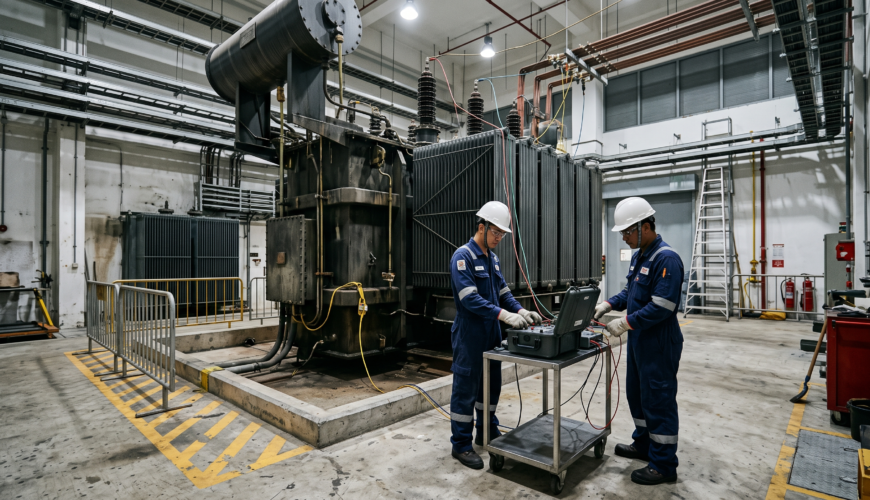
A downstream cable fault clears in under a second. Protection operates correctly, the transformer stays in service, and everyone moves on. The oil looks fine, the gas relay has not tripped, and dissolved gas analysis comes back unremarkable.
What none of those checks can see is whether the mechanical forces that passed through the windings during that fraction of a second nudged a coil out of position. Through-fault current generates enormous electromagnetic forces inside a transformer, and windings that have loosened over years of thermal cycling are the ones least able to resist them. Sweep frequency response analysis exists precisely to answer that question.
Why Electrical Tests Miss Mechanical Damage
The standard diagnostic suite looks at the insulation system. Oil analysis reports on the fluid, dissolved gas analysis reports on thermal and electrical faults producing gas, winding resistance reports on conductor and connection integrity, and insulation resistance reports on leakage to earth. A winding that has shifted a few millimetres, or a clamping structure that has relaxed, may produce entirely normal results across all of them.
Damage of that kind is nonetheless serious. A displaced winding has reduced mechanical margin against the next fault, and the next one may be the event that turns a small displacement into a turn-to-turn failure. The transformer will very often keep running perfectly well in the meantime, which is exactly what makes the condition easy to miss. Experienced transformer service companies therefore treat mechanical condition as a separate question from electrical condition, and test for it separately.
What SFRA Actually Measures
A transformer winding behaves electrically as a complex network of inductances, capacitances, and resistances distributed along its length. That network produces a characteristic response when a low voltage signal is swept across a wide band of frequencies, typically from around twenty hertz up to two megahertz. The response depends on the physical geometry of the winding, so any change in geometry changes the response.
An SFRA instrument injects that swept signal at one winding terminal and measures the transmitted signal at another, plotting amplitude against frequency to produce a trace often described as the transformer’s fingerprint. Measurement procedures are standardised in IEC 60076-18, covering measurement of frequency response on power transformers, which defines the connection arrangements and repeatability requirements that make one measurement genuinely comparable with another.
Repeatability is the whole point. Lead placement, earthing arrangements, tap changer position, and whether the bushings are clean can all shift a trace enough to look like a fault, so disciplined technique separates a useful measurement from an alarming but meaningless one.
Reading a Trace
Interpretation works by comparison. A trace is compared against a baseline taken on the same unit when it was known to be healthy, against the corresponding phase on the same transformer, or against a sister unit of identical design. Different regions of the frequency band respond to different kinds of change, so where the deviation appears tells you a good deal about what has moved.
Where Deviations Point
Low frequency behaviour, below roughly two kilohertz, is dominated by the core. Changes there tend to indicate core deformation, a shifted core earth, or residual magnetism left over from a previous direct current measurement. Residual magnetism is a common false alarm and can usually be demagnetised away before retesting.
The middle band, broadly two kilohertz to two hundred kilohertz, reflects winding geometry and is where through-fault damage most often announces itself. Axial displacement, radial buckling, hoop buckling, and loosened clamping all produce recognisable shifts in resonance position or amplitude across this region.
Above that, the response is governed by the leads and the test setup as much as by the winding itself, so deviations at the top of the sweep call for a careful look at the measurement arrangement before anything is concluded. CIGRE’s technical brochure on mechanical condition assessment of transformer windings using FRA remains the most widely used reference for working through this interpretation systematically.
Getting a Measurement You Can Trust
Because interpretation rests on comparison, the conditions of the measurement have to be reproducible. A handful of practical points account for most of the misleading traces engineers encounter:
- Record and repeat the same tap changer position every time, since each tap presents a different winding configuration
- Keep measurement lead length, routing, and earthing arrangements consistent between visits
- Clean the bushings and make earth connections directly to the tank, not to a painted surface
- Demagnetise the core after any winding resistance measurement before running the sweep
- Log oil temperature and note whether the unit was recently energised
None of this is difficult, though all of it has to be written down. A trace without its setup details cannot safely be compared against anything, which quietly wastes the measurement.
Building the Baseline You Will Need
SFRA’s usefulness depends almost entirely on having something to compare against, so good practice is to baseline at commissioning, after any relocation, and following any major work. Where a deviation is later confirmed, those findings feed directly into the decision about what happens next: confirmed winding displacement moves the conversation towards transformer core and coil repair and a proper assessment of whether the unit should return to service in the meantime. The scope of any such work depends on the transformer’s size, design, and the extent of the movement found, so figures quoted early on are indicative and firm up once the unit is opened.
When to Pick Up the Phone
Good triggers for an SFRA measurement are easy to recognise: a significant through-fault, a transport or relocation, a protection operation that nobody has fully explained, or simply the absence of any mechanical baseline on an important unit.
Our team carries out transformer testing and diagnostics across Singapore and can advise on whether a measurement is warranted after an event on your network. If a recent fault has left you wondering what it might have done inside the tank, have a word with MES and we will help you work out the right next step.

Linkedin Profile 