
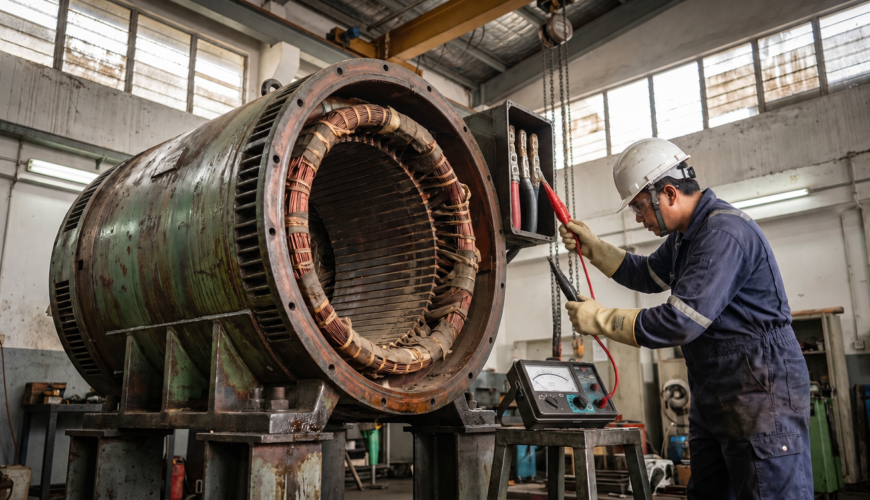
Two numbers, taken with a hand-held instrument in about ten minutes, will tell you more about the remaining life of a large alternator than almost anything else you can measure without dismantling it.
Those numbers are insulation resistance and polarisation index. Neither is new, neither is glamorous, and both are routinely skipped when a site is busy. Read properly and tracked over time, they are the closest thing the industry has to an early warning system for stator winding trouble on large industrial machines.
Why the Winding Is the Place to Look
An alternator’s stator winding lives a hard life. Copper conductors sit inside slots under constant thermal cycling, mechanical vibration, and in Singapore’s climate, persistent ambient humidity. The organic insulation separating those conductors from each other and from the earthed core is the component that ages fastest, and it is the component whose failure ends the machine’s service life.
Moisture ingress, oil and dust contamination, thermal ageing, and mechanical looseness all attack that insulation by different routes, but they converge on the same measurable symptom: the winding’s ability to resist leakage current to earth slowly falls away. Catching that decline while it is still gradual is what separates a planned intervention from an unplanned rewind, and it usually decides how much generator overhauling work a machine turns out to need when it finally comes off line.
The Two Numbers That Do Most of the Work
Insulation resistance is measured by applying a direct voltage between the winding and earth and recording the resulting current as a resistance value. For low voltage alternators, manufacturer guidance from STAMFORD and AvK, whose machines we service as an official supplier and Authorised Service Workshop for Cummins Generator Technologies (NEWAGE, STAMFORD and AvK), points to a 500 V test instrument as the normal starting point.
The absolute value carries less information than people assume. STAMFORD’s application guidance on testing winding insulation systems treats one megohm as a minimum acceptable figure for a machine in service, while a healthy new or properly stored winding would typically be expected to reach around twenty-five megohm. A reading of several megohm on a warm machine that has just come off load is not the same finding as the same reading on a cold machine that has stood idle for a fortnight.
The polarisation index adds the dimension that a single reading lacks. It is simply the insulation resistance after ten minutes divided by the value after one minute, and the method is set out in IEC 60034-27-4, covering insulation resistance and polarisation index measurement. Clean, dry insulation continues to absorb charge over those ten minutes, so the resistance keeps climbing and the ratio rises. STAMFORD’s guidance puts a good result in the order of three. Damp or contaminated insulation reaches its ceiling almost immediately, and the ratio flattens towards one.
Temperature Changes Everything
Insulation resistance falls sharply as winding temperature rises, which is why a reading taken without a recorded temperature is close to useless for trending. A hot machine will read far lower than the same machine cold, and that difference is entirely normal. Any comparison against last year’s figure needs both readings corrected to a common reference temperature, and any test report that omits winding temperature should be treated as incomplete.
What a Falling Trend Actually Means
A single low reading is a prompt to investigate, not a verdict. Surface moisture and dust on end windings can pull the value down dramatically while the insulation body underneath remains sound, and a thorough clean followed by controlled drying will often restore it.
A trend is a different matter. Readings that decline steadily across several tests, accompanied by a polarisation index drifting downwards, suggest the insulation system itself is ageing or that contamination has penetrated beyond the surface. That is the point at which a fuller assessment becomes sensible, taking in visual inspection of the end windings, winding resistance balance between phases, and where appropriate, more searching high voltage diagnostics.
Readings of this kind are also exactly what shapes the scope of any major work. A machine with sound insulation and a mechanical problem needs a very different intervention, and a very different budget, from one whose winding is approaching the end of its life. Routine insulation checks are one of the simplest ways to maintain generator performance between overhauls and to avoid discovering the answer during a shutdown.
Testing Safely on a Large Machine
Insulation testing on a large alternator is a live-working risk if it is approached casually. A few precautions apply almost universally:
- Isolate and lock off the machine, then prove dead before any test lead is connected
- Disconnect or short out electronic components such as the automatic voltage regulator, rectifiers, and surge suppressors, which test voltage can damage
- Discharge the winding fully after every test, since large windings retain a substantial stored charge
- Record winding temperature, ambient temperature, and humidity alongside every reading
Test voltage selection deserves care too. Applying more than the machine’s insulation system is designed for proves nothing useful and can shorten the life of a winding that was serviceable. Repeat high voltage testing on machines already in service is normally carried out at a reduced proportion of the original factory test value for exactly that reason.
Drying Out and When It Helps
Where low readings trace back to moisture rather than degradation, controlled drying frequently recovers the winding. Manufacturer methods range from running the machine unexcited to circulate warm air, through separately excited short-circuit running at a controlled current, to oven drying for heavily contaminated windings that have been cleaned first. The right method depends on the machine, its rating, and how wet it actually is, so this is a decision to take with the alternator’s own documentation to hand.
Making the Readings Work for You
The real gain from insulation testing comes from doing it consistently and writing everything down. A folder of dated readings, each with its temperature, turns a set of isolated numbers into a curve that tells you where a machine is heading and roughly how quickly.
If you would like a hand establishing a testing routine for your alternators, or you have readings that look lower than you expected and want an experienced view on them, our engineers would be pleased to help. Speak to the team at MES and we can look at your machines together and work out a sensible plan for them.

Linkedin Profile 