
Ask three maintenance planners how often a distribution transformer should be tested and you will get three answers, all of them defended with conviction. One tests everything annually because that is what the previous engineer did. One tests when something looks wrong. One has a schedule inherited from a spreadsheet nobody can trace.
A defensible interval is built rather than inherited. It starts from manufacturer and standards guidance, then moves up or down according to what the unit does, how hard it works, and what its own test history has been telling you.
Why a Single Interval Across the Fleet Fails
Treating every transformer on site the same way produces two problems at once. Lightly loaded units in clean, ventilated substations get tested more often than their condition justifies, absorbing budget and access time. Heavily loaded units, or units feeding a process that cannot be interrupted, get the same treatment as everything else, which is not enough attention for the risk they carry.
The alternative is straightforward in principle. Rank the units by what happens if one fails, then set the frequency of oil sampling and electrical testing so that early indicators arrive with enough warning to act on them. A unit with an installed spare and a manual changeover can tolerate a longer interval than a single transformer feeding a production line.
The Factors That Move an Interval
Five inputs do most of the work when we help clients build a schedule as part of our transformer services:
- Criticality, meaning the operational and safety consequence of an unplanned outage, and whether redundancy exists
- Load factor and loading history, since sustained high loading accelerates thermal ageing of the insulation system
- Age and known service history, including previous faults, repairs, and any period of overloading
- Installation environment, covering ambient temperature, ventilation, humidity, dust, and proximity to corrosive or salt-laden air
- The trend in previous test results, which is the strongest single indicator once you have three or more data points
Oil Tells You the Most, and Earliest
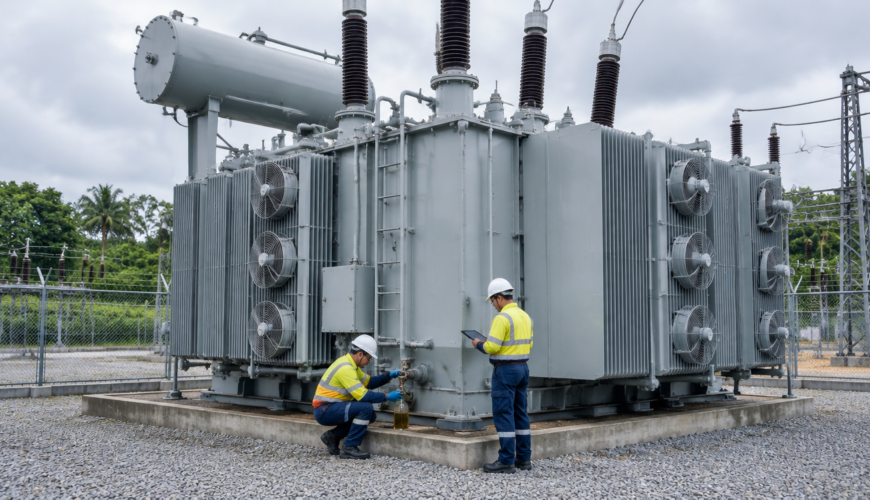
For oil-filled units, the insulating oil is the most informative and least disruptive place to look. Routine sampling supports dielectric strength measurement, moisture content, acidity, colour, and interfacial tension, and the results describe the condition of both the oil and the solid insulation it protects. International guidance on supervising oil in service, published as IEC 60422, sets out recommended tests and sampling practice by equipment category, and gives the baseline most utilities and industrial operators work from before adjusting for their own conditions.
Dissolved gas analysis sits alongside it and does something the other tests cannot. Gases generated by localised heating, arcing, or partial discharge dissolve into the oil and can be identified long before any external symptom appears. Interpretation follows established gas ratio methods described in IEC 60599, which is why a single result in isolation says relatively little and a series of results says a great deal.
This is the practical argument for a shorter sampling interval on your critical units. One sample a year gives you a snapshot. Two or four give you a gradient, and a gradient is what lets an engineer distinguish a stable, ageing transformer from one developing an internal fault. When a trend does move, the correct response is usually to shorten the interval immediately and add targeted tests, not to wait for the next scheduled visit.
Electrical Testing on the Access You Actually Get
Offline electrical testing needs an outage, so intervals are shaped by shutdown opportunities as much as by engineering preference. Insulation resistance, winding resistance, turns ratio, and dielectric loss measurements are typically grouped into a single visit during a planned shutdown, with infrared surveys and external inspections carried out live in between. On units fitted with a tap changer, the contact wear and oil condition inside the diverter compartment follow their own schedule, driven by operation counts as well as elapsed time.
Local Conditions Are Not a Footnote
Singapore’s climate has a direct effect on how quickly a schedule needs to move. Persistent high humidity increases the risk of moisture finding its way into breathing units, and moisture in the solid insulation reduces dielectric strength while accelerating thermal degradation. High ambient temperatures reduce the cooling margin a transformer has available, so a unit that runs at 80 percent load here experiences a different thermal life from an identical unit in a temperate climate.
Sites near the coast or in heavy industrial areas carry the additional problem of surface contamination on bushings and cooling surfaces. External inspections and cleaning intervals belong in the same schedule as the electrical tests, and they are often what prevents a flashover on an otherwise healthy unit. The way IEC standards guide proper transformer maintenance gives you the framework, and local conditions decide how conservatively you apply it.
Write the Schedule Down, With the Reasons
A schedule that records why each interval was chosen survives staff changes, audits, and awkward questions after an incident. For each unit, note the criticality ranking, the current interval for oil sampling and for electrical testing, the trigger conditions that would shorten it, and the date of the last review. Reviewing the whole schedule once a year against the results you have collected keeps it honest, and usually finds a few units that can be relaxed and one or two that need more attention.
Building a Schedule You Can Defend
Intervals set on evidence, reviewed once a year, and recorded with their reasoning give you a programme that stands up to scrutiny and spends attention where the risk actually sits.
MES carries out transformer testing, oil analysis, maintenance, and repair for distribution and power transformers across Singapore, and we are glad to help clients turn accumulated test results into a schedule they can defend. If you would like a review of your current intervals or a testing programme built around your own units, speak with our team.

Linkedin Profile 